
During one of the multi-cloud sessions that I attended, a participant asked about how Oracle Database@Azure/AWS/GCP differs from other popular offerings, for example, AWS Relational Database Service (RDS). Sounded like a good question and one that many are still thinking about, as the enterprises embrace multi-cloud strategies. With options like Oracle Database@AWS/Azure/GCP, Amazon RDS for Oracle, or vanilla installs on cloud compute (EC2/VMs), the decision hinges on performance, feature availability, and operational models.
In this article, I will try to touch each of these offerings intending to help decision makers choose one option versus another.
1. Deployment Models
Oracle Database@(AWS, Azure, GCP)
- Delivered and operated by Oracle, but hosted in another cloud provider’s data centers.
- Runs OCI Exadata Database Service or Autonomous Database directly inside the hyperscaler environment.
- Offers full Oracle feature set, including RAC, Data Guard, Exadata Smart Scan, In-Memory, Partitioning, etc.
Amazon RDS for Oracle
- AWS-managed Oracle service.
- Enterprise Edition available, but without advanced options like RAC, Active Data Guard, or In-Memory.
- Restricted DBA privileges and schema-level operations (AWS Docs).
- No Exadata features available.
Standalone installs on Cloud Compute (EC2/VMs)
- Full control over OS + Oracle stack.
- Only supports RAC and DG if manually built.
- Operations (patching, scaling, HA, backups) fully customer-owned.
- No Exadata features available.
2. Performance: IOPS, Throughput & Latency
Amazon RDS for Oracle
- Provisioned IOPS: Up to 256,000 IOPS with io2 Block Express, tied to Nitro instances (AWS Storage Guide).
- Throughput: Max 4,000 MiB/s at 256k IOPS; older/non-Nitro instances limited to 2,000 MiB/s (AWS Docs).
- General Purpose SSDs: gp2 max 10,000 IOPS, gp3 up to 64,000 IOPS and 4,000 MiB/s throughput (AWS Blog).
- Limitations: 16 TiB max file size, 8 KB block size only, and restricted DBA access (AWS Oracle Limits).
Compute (EC2/VMs)
- EBS-backed EC2 can also deliver up to 260,000 IOPS (AWS Whitepaper).
- Performance depends on instance type, striping, and architecture effort.
- Provides flexibility, but operational risk is higher.
Oracle Database@(AWS, Azure, GCP)
- Latency: As low as 19 µs vs. ~500 µs on AWS RDS — ~26× faster (Oracle Comparison PDF).
- Throughput: Hundreds of times greater for scan-heavy workloads thanks to Exadata Smart Scan & storage offload (Oracle Comparison).
- Modern Generations (X10M/X11M): Up to 2.2× faster analytics scans and 21 µs OLTP reads (Wikipedia Exadata).
- Dynamic Scaling: RAC enables non-disruptive scale-out.
3. Feature Set Comparison
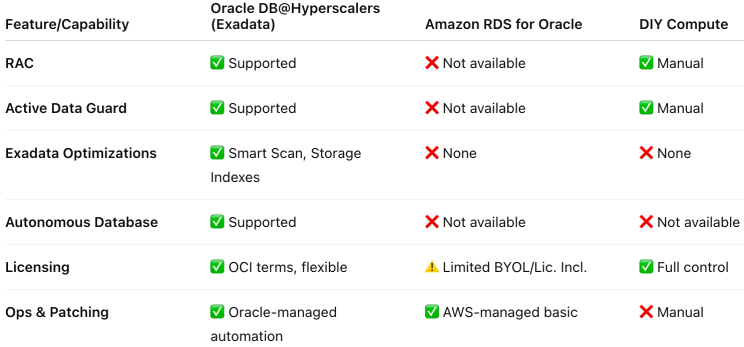
4. Benefits of Oracle Database@(AWS, Azure, GCP)
- Enterprise Features: RAC, DG, Exadata storage intelligence.
- Performance: Ultra-low latency (19 µs vs. 500 µs), superior throughput, analytics acceleration.
- Operational Simplicity: Oracle automates patching, backups, tuning, and scaling.
- Multi-Cloud Strategy: Place Oracle close to workloads in AWS/Azure/GCP while retaining Exadata power.
- License Portability: Flexible OCI licensing vs. general license restrictions.
5. Choosing the Right Model
- Oracle Database@(AWS, Azure, GCP) → Best for mission-critical OLTP, large-scale DW, RAC/DG, and Autonomous needs.
- Amazon RDS for Oracle → Best for mid-tier workloads that need simplicity and AWS-native integration.
- Installs on Compute → Best for custom Oracle stacks with not great scalability requirements, and in-house DBA/SRE expertise willing to manage HA/DR manually.
Ultimately, the choice depends on workload demands:
- RDS is cost-effective and simple, but limited in features and capped in performance (max 256k IOPS, 4 GiB/s throughput).
- Installs on compute offers flexibility but requires significant operational maturity and lacks the Exadata features.
- Oracle Database@AWS/GCP/Azure (Exadata) unlocks the full Oracle feature set with order-of-magnitude better performance (latency as low as 19 µs), seamless scaling, and Oracle-managed operations — making it the top choice for enterprise-grade, mission-critical workloads.
Discover more from IT-Noesis
Subscribe to get the latest posts sent to your email.


